

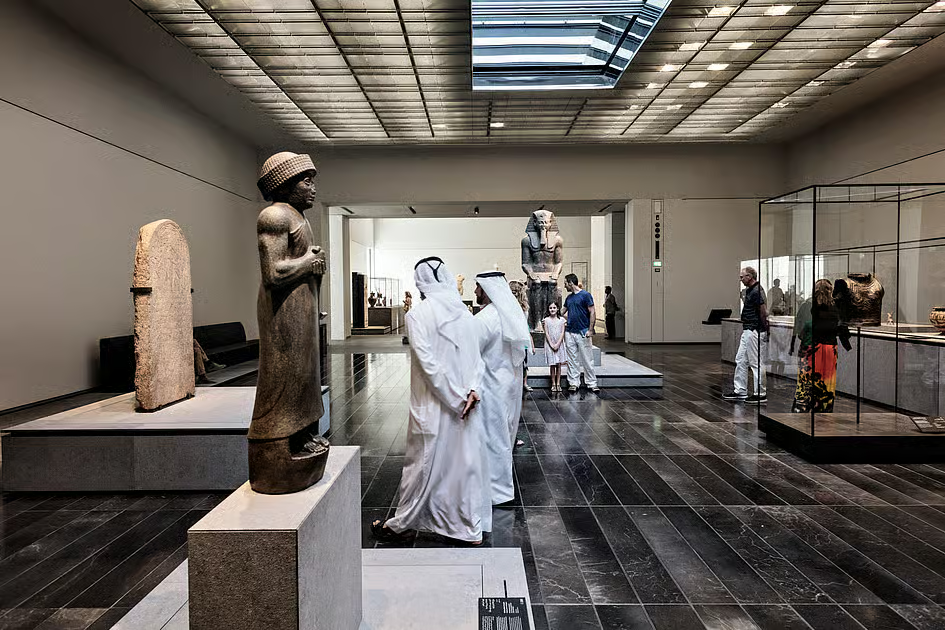
Nearly a decade after Louvre Abu Dhabi opened its doors, the museum looks considerably different from the institution visitors first encountered in 2017.
At the time, only around 30 per cent of the artworks displayed belonged to Louvre Abu Dhabi itself, with the remaining 70 per cent largely coming through loans from French museums and regional lenders. Today, nearly two-thirds of the works presented across its four chronological worlds are owned by the Abu Dhabi museum.
Now, the woman who previously played a role in building that collection will return to lead its next phase.
Dr Souraya Noujaim has been appointed Director of Louvre Abu Dhabi, the Department of Culture and Tourism – Abu Dhabi (DCT Abu Dhabi) announced on October 7. The appointment comes ahead of the museum’s 10th anniversary in 2027.
An art historian and curator specialising in Islamic art history and archaeology, Noujaim most recently served as Director of the Department of Islamic Arts at the Musée du Louvre in Paris and Chief of the French Grand Department of Islamic Art Heritage. There, she was responsible for a collection of 18,000 Islamic artworks.
Her new role in Abu Dhabi will extend far beyond the museum’s exhibitions. Noujaim will oversee its overall strategic direction, including collection development, research, conservation, education, public engagement, visitor experience and institutional growth.
From building the collection to leading the museum
It is familiar territory for Noujaim, whose relationship with Louvre Abu Dhabi stretches back more than a decade.
She was involved in developing its early intellectual and curatorial vision and, in February 2018, became its first Scientific, Curatorial and Collections Management Director.
Until April 2023, she oversaw the museum’s curatorial activities, including strategic acquisitions that helped grow its permanent collection. “Louvre Abu Dhabi holds a special place in my professional and personal journey,” Noujaim added following the announcement.
She said her priorities would include expanding and enriching the collection, strengthening the museum’s relationship with local and international audiences. “I am honoured to return to Abu Dhabi and lead this remarkable institution into its next chapter.”
Louvre Abu Dhabi’s decade-long evolution
That next chapter comes after a period of considerable growth for the Saadiyat Island museum.
More than eight million people have visited Louvre Abu Dhabi since it opened in November 2017. In that time, it has staged 22 temporary exhibitions, five editions of Art Here and six exhibitions at its Children’s Museum. Perhaps one of the biggest changes, however, has taken place inside its permanent galleries.
Its permanent collection spans thousands of years, from prehistoric objects and religious texts to paintings and contemporary works, while rotating loans continue to come from 19 French partner institutions as well as regional and international museums.
The museum’s chronological approach was conceived to place objects from different civilisations alongside one another, drawing attention to connections and exchanges between cultures rather than presenting their histories in isolation.
Mohamed Khalifa Al Mubarak, Chairman of DCT Abu Dhabi and President of Louvre Abu Dhabi, said Noujaim’s experience would help strengthen the museum’s position as it moves forward.
“Since 2017, [Louvre Abu Dhabi] has contributed greatly to the Emirate’s status as a global cultural capital. Dr Noujaim has been part of the museum’s journey from its earliest stages, helping shape its collection, scholarly foundations and distinctive universal narrative,” he said.
As Louvre Abu Dhabi prepares to enter its second decade, “Noujaim’s international expertise and deep understanding of what makes Louvre Abu Dhabi unique will contribute to the museum’s role as a leading cultural institution in the region and on the global stage,” he added.
Designed by French architect Jean Nouvel, Louvre Abu Dhabi opened on Saadiyat Island in November 2017 following an agreement between the governments of Abu Dhabi and France. Its vast dome, inspired by traditional Islamic architecture, has since become synonymous with the museum and its signature “rain of light”.
Source: Khaleej Times
