

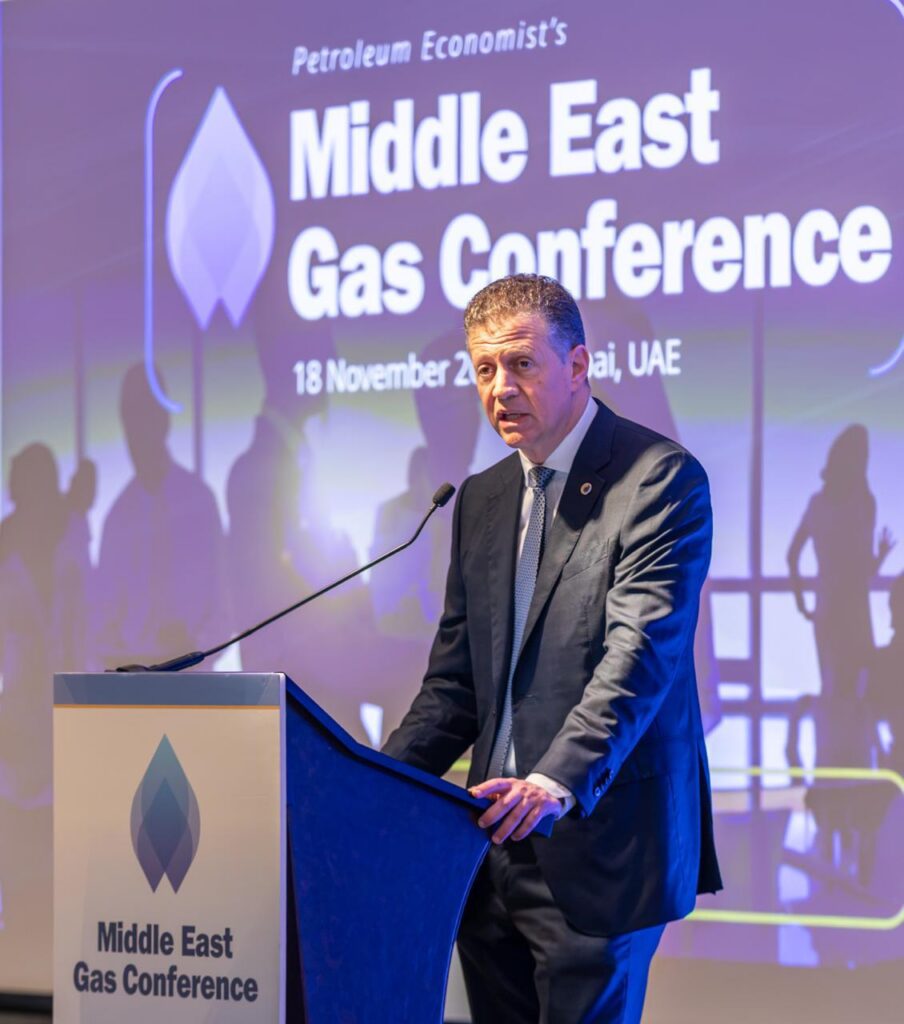
DUBAI, 18th November, 2026 (WAM) — The Middle East’s gas industry must be built for resilience as well as growth, requiring well over US$200 billion of investment by 2030 in domestic supply, cross-border connections, and protected infrastructure, industry leaders attending the Middle East Gas Conference at the Waldorf Astoria DIFC in Dubai said today.
The second Middle East Gas Conference, held under the theme “Powering Progress Through Partnership: Advancing Gas Infrastructure Across the Middle East”, convened more than 150 senior policymakers, executives from leading NOCs and IOCs, investors, and infrastructure developers to assess the region’s new gas realities, from upstream and tight gas to financing, cross-border alliances, and Iraq’s gas future. The event was organised by Petroleum Economist in partnership with host sponsor Crescent Petroleum, the region’s oldest and largest private oil and gas company. Speakers included senior executives from ADNOC Gas, XRG, Dana Gas, Bapco Energies, and the International Energy Forum, as well as leaders from the energy finance sector including KKR and Aberdeen Investcorp Infrastructure Partners.
Majid Jafar, CEO of Crescent Petroleum and Board Managing Director of Dana Gas, in the opening speech of the conference, said, “Our region holds around 40 percent of the world’s proven gas reserves and the past nine months have made clear how vital it is for the global economy. We must invest not only to grow, but to make that growth resilient. This needs greater investment in new production, cross-border pipelines, export capacity beyond the Strait of Hormuz, and the storage that keeps supply flowing when routes close. Add these together, and the investment required is well over US$200 billion by 2030. That is the largest opportunity our industry has seen in a generation.”
Participants at the conference emphasised the need to develop more of the region’s own gas with fiscal terms that reward the risk, to build cross-border pipelines that give producers more than one route to market and consumers more than one source of supply, and to make it easier to finance and protect that infrastructure, with resilience now an investable asset class in its own right.
Jafar noted that Crescent Petroleum and Dana Gas have invested more than US$4 billion in gas in the Kurdistan Region of Iraq, the largest private investment in the country’s gas sector and the largest investment from the GCC in Iraq. Investors continue to demonstrate confidence in the region’s gas, he said, with Pearl Petroleum’s $500 million bond, placed earlier this month, attracting demand of 1.7 times the issue size.
Paul Hickin, editor-in-chief and chief economist, Petroleum Economist, concluded, “The energy and ambition in the room throughout this conference showed a region determined to lead. Middle East gas has never been more important to the world, and the partnerships forged here will help build the connected, resilient infrastructure that powers the region’s growth for decades to come.”
Source: Emirates News Agency
